September 4, 2026
Top Pentagon Official Contracted Personal Lawyer to Handle Minerals Deal — discovered via Hacker News; pending review.
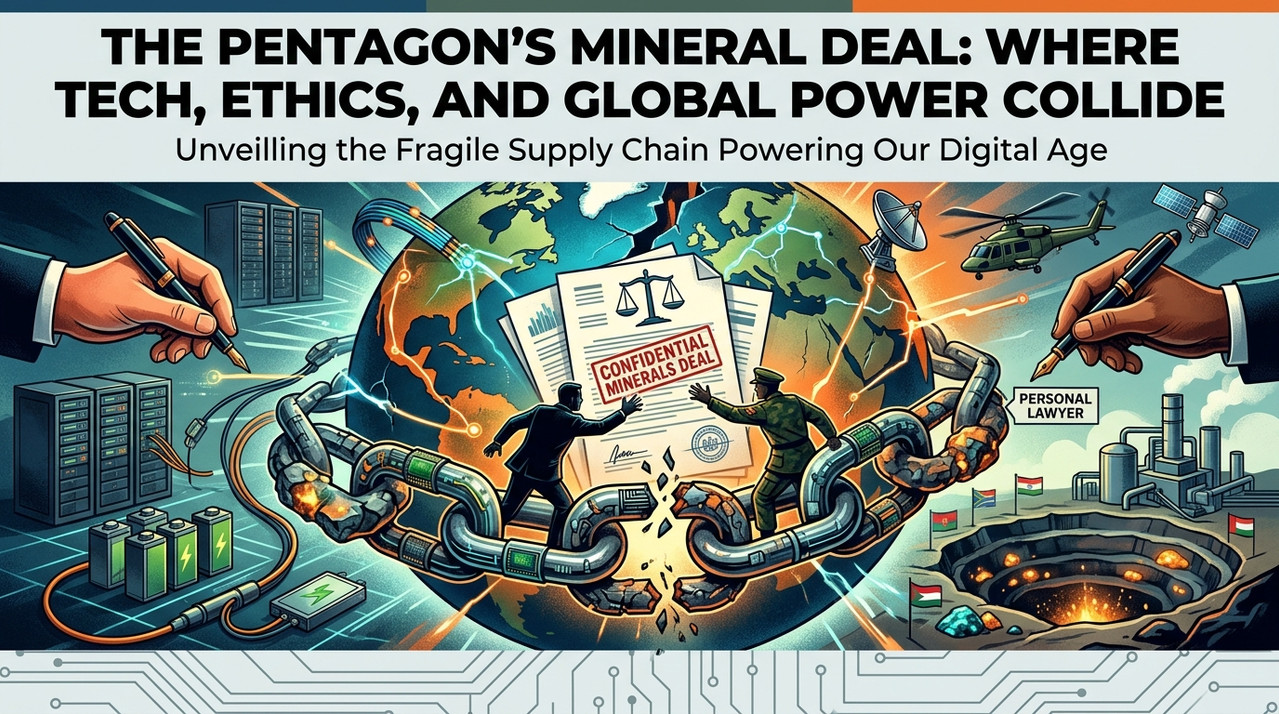
A recent revelation that a top Pentagon official contracted their personal lawyer to handle a significant minerals deal has sent ripples through both the defense and technology sectors. While the immediate focus is on potential conflicts of interest and ethical breaches, the underlying story highlights a critical vulnerability for the modern world: the complex, often opaque, and highly strategic global supply chain for the minerals that power our technology.
For developers building the next generation of applications, hardware, and infrastructure, the importance of minerals like lithium, cobalt, nickel, and rare earth elements is often abstract. Yet, these materials are the literal bedrock of the digital age. They are essential components in semiconductors, batteries for electric vehicles and data center backup power, fiber optic cables, and even the permanent magnets in countless motors and sensors. The concentration of processing and refining capabilities for these minerals in a small number of nations creates a significant point of geopolitical and economic fragility. A disruption in this supply chain, whether due to conflict, trade disputes, or policy shifts, can have immediate and severe consequences for tech manufacturing and innovation worldwide.
The U.S. Department of Defense's interest in securing mineral supply chains is not merely about conventional munitions. It's about maintaining a technological edge. Advanced military systems—from stealth aircraft and guided missiles to satellite communications and cyber warfare tools—are intensely mineral-dependent. The Pentagon's involvement in negotiating or facilitating these deals is a direct effort to ensure a stable and reliable flow of these strategic materials, reducing reliance on potentially adversarial sources. This moves the issue far beyond simple procurement into the realm of national security strategy.
The specific arrangement involving a personal lawyer raises serious questions about transparency and the potential for private interests to influence public policy. When officials use personal connections or legal counsel to navigate complex commercial negotiations, it risks undermining public trust and creating a system where access and influence, rather than strategic merit, dictate outcomes. For the tech industry, which often champions transparency and ethical sourcing, this situation serves as a stark reminder that the raw materials for its products are frequently entangled in a web of finance, law, and international politics that is far from clean or straightforward.
The situation underscores a fundamental challenge for technologists and policymakers alike: securing the mineral foundations of our digital world requires a strategy that is as sophisticated as the technology it enables, and one that is executed with the highest standards of integrity and public accountability.
Further reading: https://prospect.org/2026/08/21/pentagon-minerals-deal-department-defense-cerberus-capital-alan-waldenberg-stephen-feinberg/

Discover 3 powerful websites to learn new skills, turn ideas into apps, and manage multiple virtual phones from one place. 🚀
Sep 1, 2026

Bio-computing is real. Actual neurons wired into computing systems. Here's what that means, why it matters, and where it gets weird.
Aug 31, 2026
